
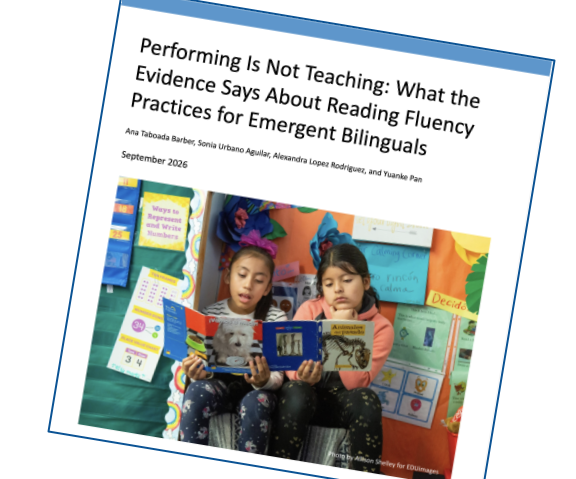
Authors: Ana Taboada Barber, Sonia Urbano Aguilar, Alexandra Lopez Rodriguez, and Yuanke Pan
Abstract
This paper synthesizes evidence from eleven research studies to evaluate reading fluency practices for emergent bilinguals in elementary grades. The most consistently supported practices across the literature are repeated reading, fluent reading modeling or assisted reading, and immediate corrective or progress feedback. These practices are most effective when instruction is explicit, structured, and delivered using appropriately challenging, meaningful texts. For emergent bilinguals specifically, the evidence supports integrating oral reading practice with vocabulary and oral-language support and, where appropriate, primary-language scaffolding. The review also highlights a notable mismatch regarding Readers’ Theater: while widely used in classrooms, the limited research base makes it difficult to isolate benefits attributable specifically to its performance elements beyond the repeated reading and other supports embedded within the routine. Additionally, the paper identifies a widespread “prosody gap,” with limited explicit instructional guidance in phrasing, rhythm, and expression for multilingual learners. Ultimately, the authors advocate for scaffolded repeated reading routines paired with meaningful, appropriately challenging texts and innovative technologies to foster equitable reading development for emergent bilinguals.